
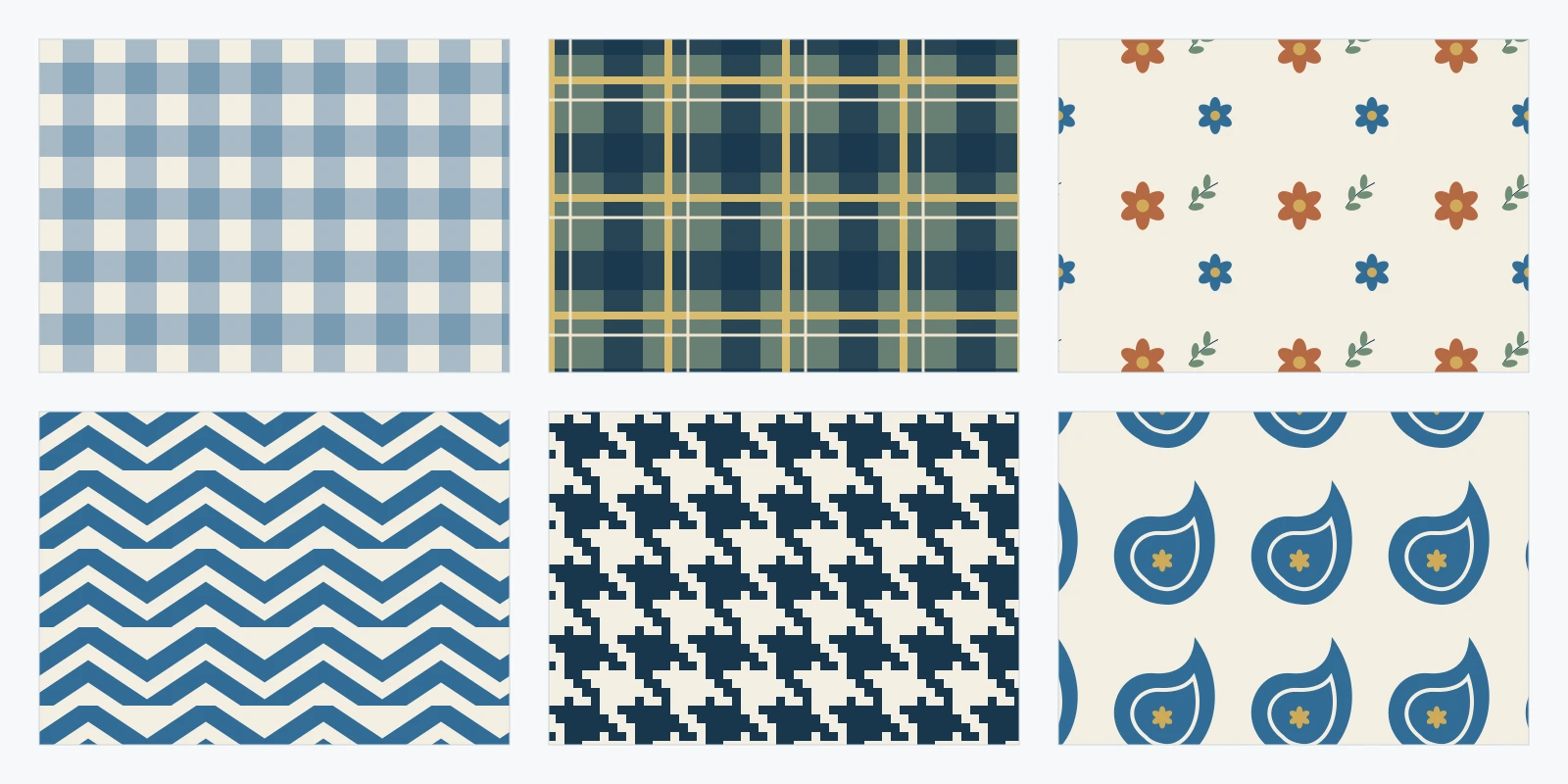
Common fabric pattern names include stripes, polka dots, gingham, plaid, chevron, herringbone, houndstooth, floral, paisley and toile. Start by looking at the repeated shape, the spacing between shapes, and the way lines cross. Color alone rarely identifies a design.
This guide is about the visible surface pattern. A sewing pattern is a set of garment pieces; a weave describes how yarns interlace; a repeat layout describes how a design tile is placed. Those terms can overlap in fabric listings, so the distinctions matter when you are buying cloth, describing a reference, or preparing artwork for print.
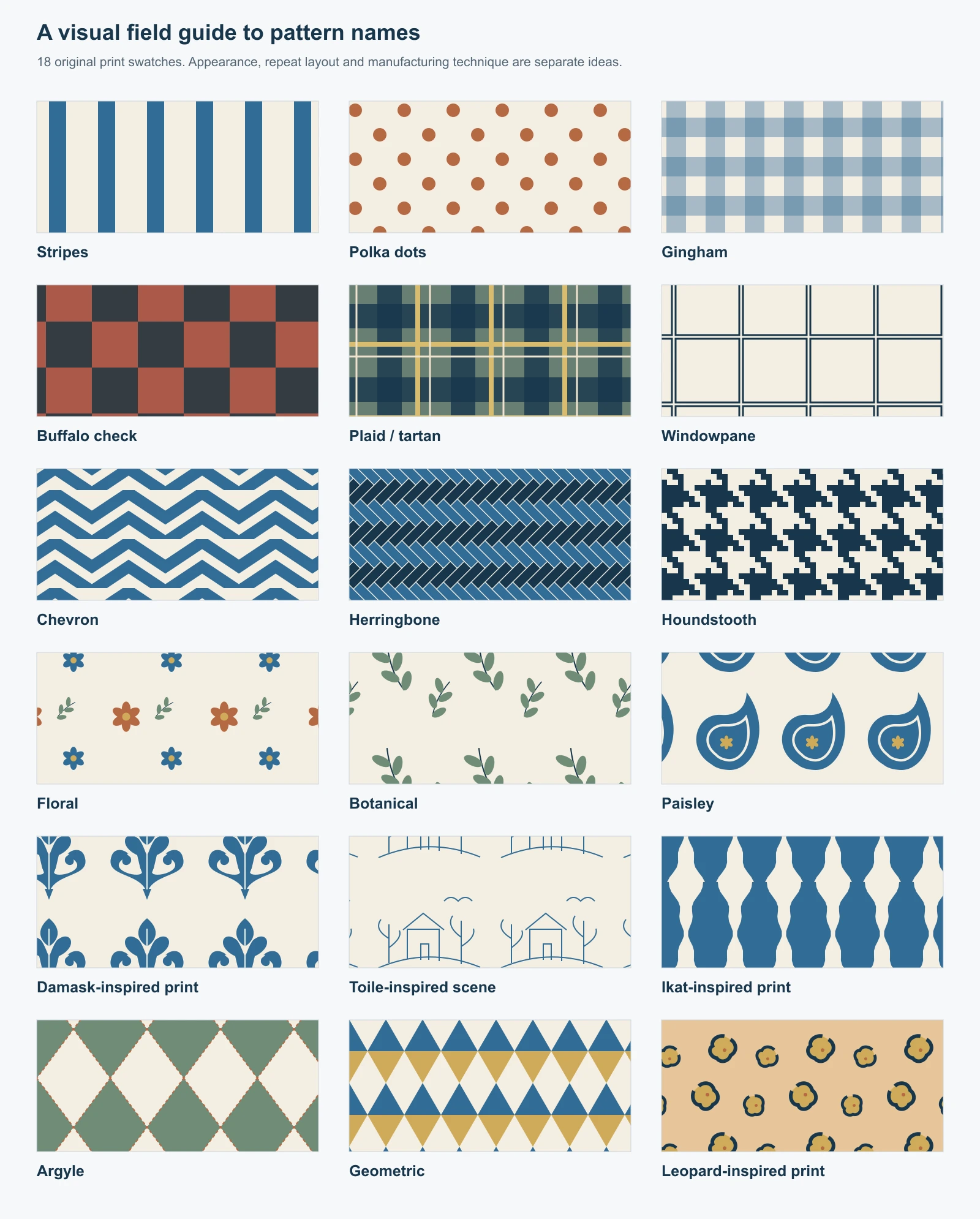
The swatches are original illustrations of visual designs. A printed damask-style ornament or ikat-style graphic does not establish that cloth was woven or dyed using the corresponding textile technique. Use the pictures for comparison, then check the supplier's material and construction details when those properties matter.
Quick fabric pattern name lookup
| What you see | Name to investigate | Useful distinction |
|---|---|---|
| Parallel repeated bands | Stripes | Direction and band width matter |
| Similar circles at regular intervals | Polka dots | Check the row arrangement |
| Even crossing bands with intermediate tones | Gingham | Usually a simple, balanced check |
| Bold, often large, contrasting checks | Buffalo check | Retail usage can overlap with gingham |
| Crossing bands with a more involved color sequence | Plaid and tartan | Follow the complete stripe sequence |
| Fine lines around wide open squares | Windowpane | The open space dominates |
| Continuous zigzag bands | Chevron | Points connect into a continuous zigzag |
| Offset short diagonal segments | Herringbone | Broken turns distinguish it from chevron |
| Small jagged or tooth-like checks | Houndstooth | The unit is not a plain square |
| Flowers or blossoms | Floral | A motif family, not one repeat layout |
| Leaves, stems or broader plant imagery | Botanical | Can include floral designs |
| Curved droplet forms with ornament | Paisley | Look at the hooked outer silhouette |
| Formal, often symmetrical ornament | Damask | Appearance does not prove woven construction |
| Illustrated scenes on a contrasting ground | Toile | Usually more narrative than a floral scatter |
| Feathered color boundaries | Ikat | A visual imitation differs from yarn-dyed ikat |
| Repeated diamonds, often crossed by fine lines | Argyle | Diagonal organization is the clue |
| Repeated abstract shapes or grids | Geometric | A broad family rather than one exact design |
| Coat, fur or skin-inspired markings | Animal print | Irregularity helps distinguish it from regular dots |
Lines, dots and checks
1 Stripes
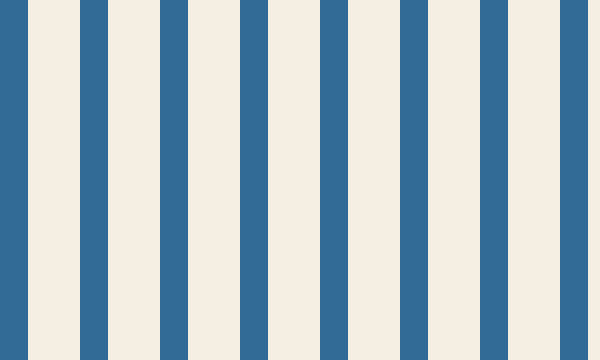
Stripes repeat bands in one dominant direction. Describe them more precisely with horizontal, vertical or diagonal, then add narrow, wide, even or irregular. A navy stripe on cream tells a buyer more than “blue fabric.”
For a digital tile, inspect both the band edges and the full spacing cycle. An arbitrary crop can produce a double-width stripe where neighboring tiles meet. Thin bands also need a final-size proof because reduction can merge them or make their contrast uneven.
2 Polka dots
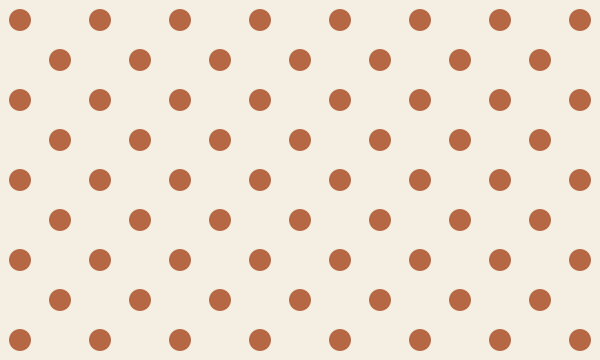
Polka dots use repeated round spots, commonly with consistent size and spacing. A regular grid, staggered rows, and a loose scatter can all feel different even when they share the same circle artwork. Include the arrangement when describing your reference.
Watch any circle cut by a tile edge. Its continuation must land at the matching position on the opposite side. When reviewing a repeat, compare the empty spaces too; an uneven gap can reveal the tile even when every dot is intact.
3 Gingham
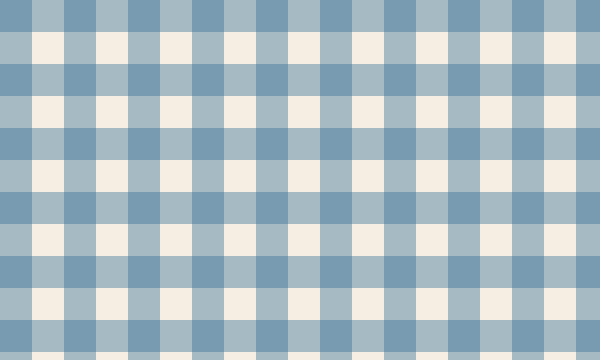
Gingham is recognized by a regular check formed by crossing bands of equal width, often with a light ground and an intermediate intersection tone. Traditional gingham uses colored yarns, while a digital print can imitate the same appearance. Artlandia's gingham entry is a useful visual reference.
Preserve the complete light, medium and dark sequence when cropping. Matching one square is not enough if the next band begins in the wrong phase. Use nearest-edge inspection as well as a wider repeated view.
4 Buffalo check
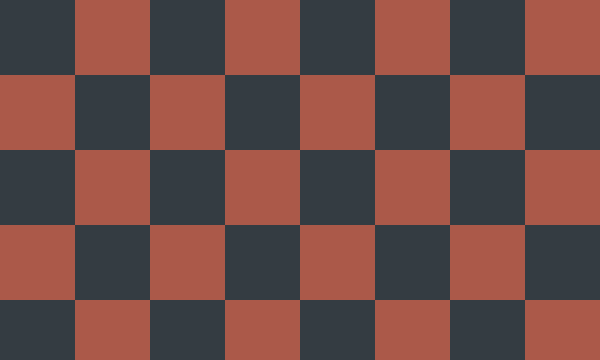
Buffalo check usually describes a bold, relatively large check associated with strong two-color combinations. Shop labels can overlap with gingham, so a name alone may not settle an ambiguous sample. Specify the check size, colors and intersection appearance.
Large squares make alignment errors conspicuous. Check the actual repeat boundary at full size, then inspect the design at its intended physical scale. A check that looks balanced in a small thumbnail can dominate a sleeve, cushion or tumbler once printed.
5 Plaid and tartan
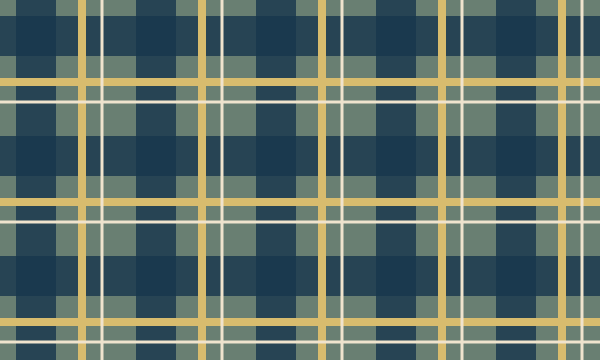
Plaid combines crossing colored bands, often in several widths. Tartan has a more specific textile and cultural context; it should not be treated as a casual synonym for every grid. When exact identity matters, compare the full band sequence and use an authoritative tartan reference rather than assigning a clan or historic name from appearance.
For artwork, identify one complete horizontal and vertical sequence before defining the tile. A partial sequence can create a convincing small preview but a mismatched border across a larger surface.
6 Windowpane
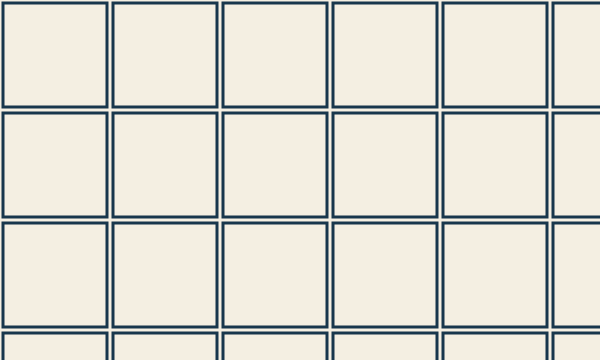
Windowpane uses comparatively fine crossing lines around large open squares or rectangles. The open ground is a strong part of its appearance. It is useful to distinguish this from dense checks where the filled bands are more visually dominant.
A one-pixel line displacement can be easier to see here than in a busy floral. Inspect line continuity and thickness at both tile boundaries. If automatic seam repair bends a line, use an editable source or manual correction rather than accepting a lower edge score alone.
Zigzags and angular units
7 Chevron
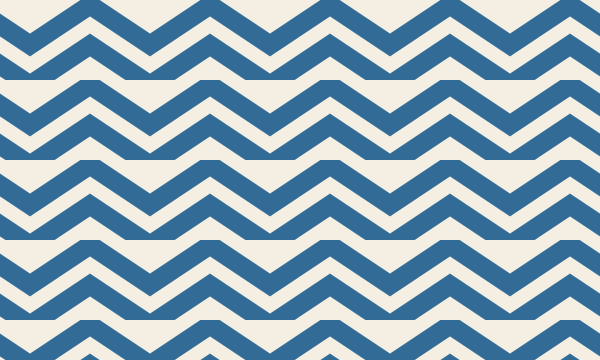
Chevron is a sequence of connected V-shaped zigzags. Look for continuous bands through each point. Width, angle and spacing can vary, but the connected zigzag is the useful starting clue.
Follow a band across the entire repeated preview. It should continue at the same angle and thickness. A crop through the wrong phase can produce a sudden flat segment or an extra-wide peak at the join, even when the palette looks consistent.
8 Herringbone
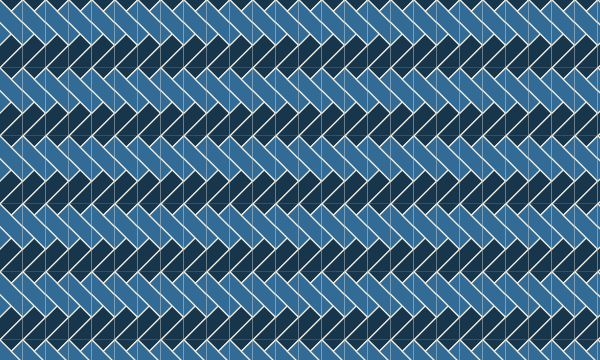
Herringbone has broken, offset turns rather than chevron's continuous zigzag bands. In actual fabric construction, CottonWorks describes herringbone as a broken twill with alternating twill directions. A printed herringbone illustration reproduces the visual arrangement without producing that weave.
Check the short units where a direction changes. Blending that makes their corners soft can reduce the character of the design. Keep a larger repeated view beside the original tile when judging an edge repair.
9 Houndstooth
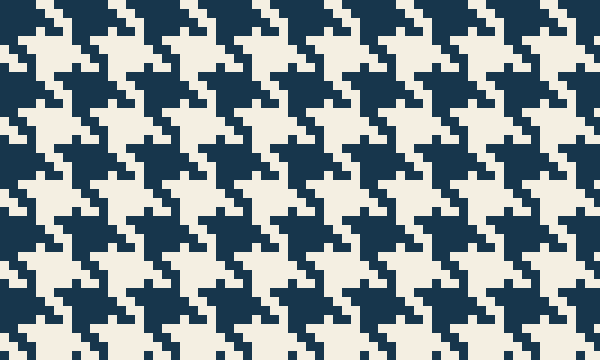
Houndstooth is a broken check with jagged, tooth-like shapes. At a distance, a small version may read almost like texture. Zoom in and look at the outline of one unit to distinguish it from an ordinary square check.
Preserve the corners and small gaps that separate neighboring units. Overaggressive smoothing can turn the pattern into an indistinct diagonal mesh. Proof both a close crop and the final print size, particularly when the units are very small.
Flowers, plants and curved motifs
10 Floral
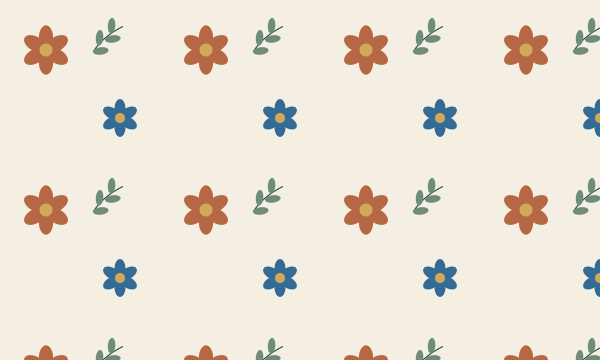
Floral describes flower-based motifs. It does not specify realism, scale, density or placement. A tiny tossed blossom and a large formal flower arrangement are both floral but need very different production decisions.
Look for clipped petals, duplicated stems and channels of empty ground in the repeat. A technically clean border can still create an obvious row of identical flowers. Use the floral pattern workflow for a source-focused starting point, then inspect the motif rhythm at product scale.
11 Botanical
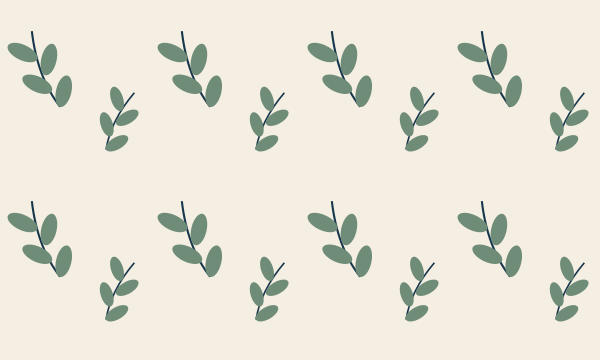
Botanical is a broader plant-based description that can include leaves, stems, branches, seed forms and flowers. Use it when the plant structure is more informative than simply calling the design floral. Botanical and floral are overlapping categories.
Long branches make useful continuity checks. Trace them through the repeated edges and look for doubled leaves near the join. A recognizable isolated branch can also become a repeated landmark, so inspect several tiles rather than one repaired boundary.
12 Paisley
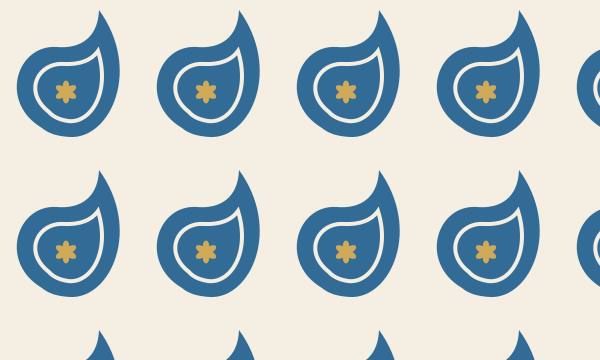
Paisley uses a curved droplet or hooked teardrop form, often filled with smaller ornamental detail. Identify the outer shape before considering the internal decoration. The motif may be upright, rotated or mixed at several scales.
Detailed curves can hide a small join in a thumbnail while making distortion obvious close up. Compare the source silhouette with the repaired version. When the exact decorative drawing matters, retain editable motifs and use a controlled manual wrap instead of repeatedly redrawing the boundary.
Ornament and textile-inspired appearances
13 Damask
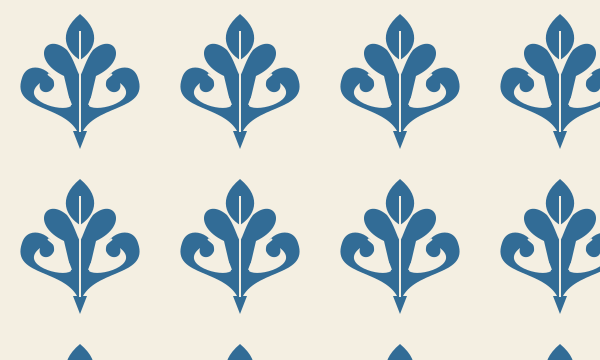
Damask is a textile construction term as well as a visual label used in print listings. Actual damask is a reversible figured woven fabric. Sellers also use “damask pattern” for formal, often symmetrical ornamental artwork that resembles that appearance.
Our swatch is a damask-inspired print illustration. Its symmetry does not prove a fabric's construction. In a repeat, check the central axis, paired curves and vertical spacing; a damaged half-motif can disrupt the symmetry over an entire panel.
14 Toile
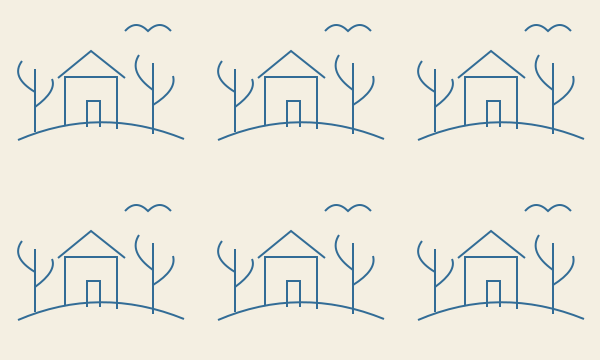
In surface-pattern descriptions, toile commonly means toile de Jouy-style illustrated scenes, often rendered in one color against a light ground. The scenes can include people, buildings, animals or landscape. It is more narrative than a simple scattered flower.
Treat recognizable scenes carefully at tile boundaries. Splitting a face, building or animal at the wrong place can produce a confusing continuation. Preserve meaningful subjects and check how neighboring scenes sit together when the design is repeated.
15 Ikat
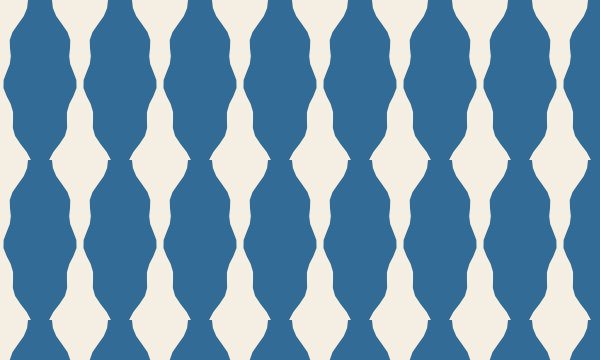
Ikat is a yarn resist-dyeing technique that creates a pattern before weaving, as the Australian Museum explains. An ikat-inspired print imitates aspects of that visual character, often including feathered color edges.
Do not automatically treat every soft boundary as an export defect. Compare the intended drawn edge with the source resolution. The repeat still needs coherent placement, but sharpening away the characteristic edge texture may change the design you wanted to keep.
Diamonds, broad geometry and animal markings
16 Argyle
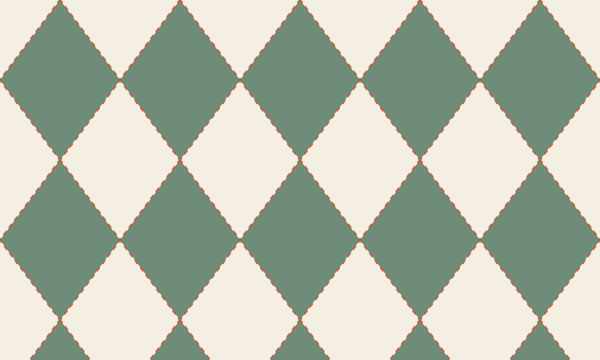
Argyle organizes diamonds along diagonal axes, often with finer diagonal lines crossing the larger shapes. It is strongly associated with knitwear, but the visual design can also be printed on other surfaces.
Follow both layers through the repeat. Large diamonds may connect correctly while a thin overlaid line jumps or changes angle at the border. Avoid judging the result only from the larger colored shapes, especially after reducing the tile for a small product.
17 Geometric
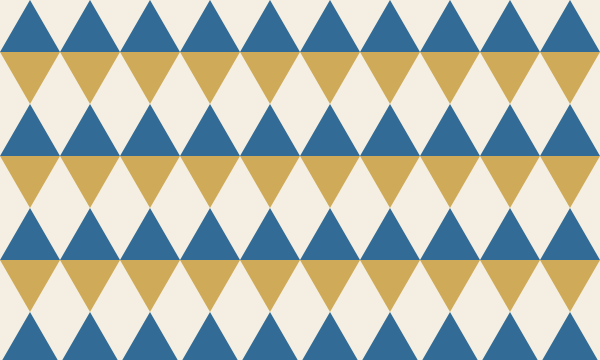
Geometric is an umbrella term for designs built from shapes such as circles, triangles, polygons and grids. Chevron and argyle can fit inside this larger family. For a useful search or production brief, add the shape, density, scale and arrangement.
“Small two-color triangle grid” is more actionable than “geometric pattern.” Test whether the whole shape sequence repeats, including its gaps and rotations. Very regular geometry exposes even small edge shifts, so compare the repaired corners against the source.
18 Animal print
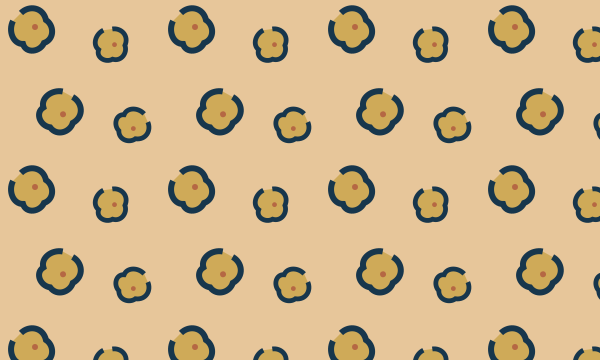
Animal print refers to designs inspired by animal skin, fur or coat markings. Leopard-style rosettes, zebra-style stripes and other markings belong to different subfamilies. Name the specific marking when you can rather than treating animal print as one uniform pattern.
Large distinctive spots can reveal a small source tile when repeated. Check their distribution across several tiles. Preserve intentional irregularity while looking for hard rectangular seams or abrupt changes in the size and direction of the markings.
Commonly confused pattern names
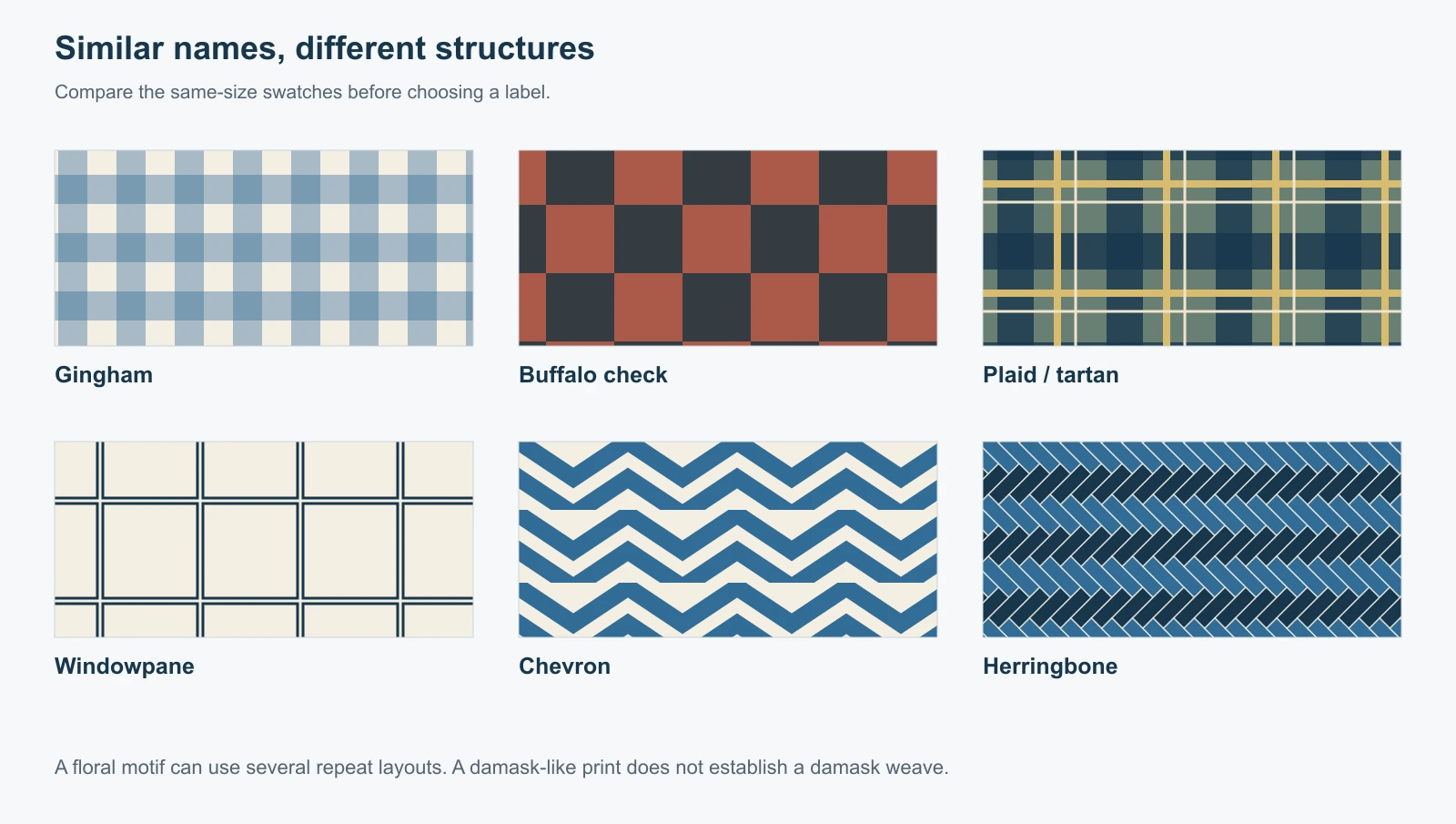
Gingham, buffalo check and plaid. Begin with the full band sequence. Gingham usually has a simple even check; buffalo check is commonly sold as a bold, larger check; plaid can use more involved bands and widths. Retail naming is not perfectly standardized, so include a measured check size and a clear image when ordering.
Chevron and herringbone. Follow the turn. Chevron connects into a continuous zigzag, while herringbone uses offset segments and broken turns. A thumbnail can obscure that difference. Inspect one direction change at a larger scale.
Floral and botanical. These describe subject matter, and one design can be both. Neither tells you whether the layout is straight, half-drop or brick. Include the repeat arrangement separately when preparing a file.
Motif, repeat layout and textile technique
A complete description might be “small botanical sprigs in a half-drop layout, printed on cotton.” Botanical describes the subject, half-drop describes placement, printing describes the application process, and cotton names the fiber. Each part answers a different production question.
Changing the layout does not rename the motif. The same paisley drawing can sit in a straight grid or an offset arrangement. Likewise, printing a herringbone illustration does not create a broken-twill weave. Ask for a material sample or construction information when purchasing actual fabric.
When preparing raster artwork, specify the source tile dimensions, physical repeat scale, layout, final canvas size and required file format. The fabric-pattern workflow explains the handoff from a source image to a production canvas.
Use the original swatches to practice repeat inspection
Download the original practice swatches
and choose a design with clear edges. These editable SVG illustrations are practice graphics, not photographs of woven samples. Export a raster PNG before using tools that accept raster images.
View the PNG in the Pattern Checker. First inspect technical continuity, then examine the larger composition. If it needs repair, the image-to-seamless pattern tool can process an existing raster image; it does not identify its style automatically or recreate editable vectors. Review any changed motifs before export.
Use Pattern Filler when a good tile needs a larger canvas. Choose the layout and scale for the intended product. A pattern name gives you a useful vocabulary, but the exported file still needs a repeat and print-size check.
Frequently asked questions
How can I find the name of a fabric pattern?
Identify the basic marks first, then check their spacing, direction and intersection. Compare the close-up unit with the full repeated surface. Search with shape, scale and color details when the broad name is ambiguous.
Are plaid and gingham the same?
Gingham has a simple, regular check. Plaid is a broader description of crossing bands and often uses more complex widths or color sequences. Store labels can overlap, so confirm the actual swatch and check size.
Is a floral print always a seamless repeat?
No. Floral identifies the motifs. A floral picture can be a placement graphic, an unfinished design, or a repeating tile. Test opposite edges and the larger layout before filling a surface.
Can a photo prove whether a pattern is woven or printed?
A surface image may suggest a technique, but it is not a complete construction specification. Check the supplier's fabric description, yarn and weave information, and a physical sample when those properties affect your project.
Can SeamlessCanvas automatically tell me a pattern name?
No. This field guide supports manual comparison. The product checks or repairs repeating raster artwork and helps prepare a larger canvas. It does not provide a pattern-classification service.